

The short answer
A softswitch is the software that connects, routes and bills voice calls over IP networks. It replaced the hardware telephone exchange. There are two main types:
- A Class 4 softswitch is a wholesale switch. It moves large volumes of calls between carriers, usually long-distance and international, and makes money on routing.
- A Class 5 softswitch is a retail switch. It serves end users, businesses and subscribers directly, with features like extensions, voicemail, IVR and call forwarding.
Carriers and wholesale VoIP traders need Class 4. Operators, ITSPs and businesses that sell calling to end users need Class 5. Many providers run both, with Class 5 serving their customers and Class 4 carrying the traffic out to the world.
What a softswitch does
Every softswitch, whichever class, handles the same core jobs:
- Signalling. Setting up, maintaining and ending calls, almost always over SIP today, with H.323 still found on some older carrier links.
- Routing. Deciding where each call goes, based on the dialled number, cost, quality and rules you set.
- Media handling. Passing the voice stream, and transcoding between codecs when the two sides speak differently.
- Gateway to the phone network. Bridging IP calls to and from the traditional phone network (PSTN) and mobile networks through operators.
- Billing and CDRs. Recording every call as a call detail record and rating it against a price list, so you can invoice customers and reconcile with suppliers.
- Monitoring and reports. Live views of concurrent calls, answer rates and call duration, so problems are caught before customers notice.
Because it is software running on standard servers or in the cloud, a softswitch scales by adding capacity rather than buying new hardware, and new features arrive as software updates.
Class 4 softswitch: the wholesale switch
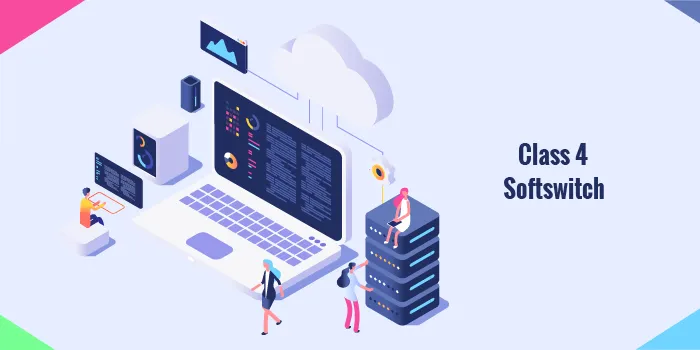
A Class 4 softswitch sits between carriers. Traffic comes in from customers who are themselves carriers or resellers, and goes out to the suppliers who terminate it in each country. It never talks to an end user's phone directly.
What matters in a Class 4 switch:
- Routing logic. Least-cost routing (LCR), quality-based routing, percentage splits across suppliers, prefix and longest-match rules, and automatic failover when a route degrades. Routing is where a wholesale business makes or loses its margin.
- Capacity. High concurrent calls and calls per second (CPS), so traffic peaks do not drop calls.
- Integrated billing. Rating every call for both the customer and the supplier, with rate-deck imports, so margin is visible per route, per customer and per country.
- Quality metrics. ASR (answer-seizure ratio), ACD (average call duration) and PDD (post-dial delay) per route, so bad routes are spotted and removed quickly.
- Protocol and codec conversion between carriers that use different signalling or codecs.
- Fraud controls such as call limits, blocked destinations and alerts on unusual traffic.
Who uses it: wholesale voice carriers, VoIP traders, international long-distance operators, and CPaaS and retail providers that need to send their own traffic out to many suppliers. Our wholesale voice business runs on exactly this model.
Class 5 softswitch: the retail switch
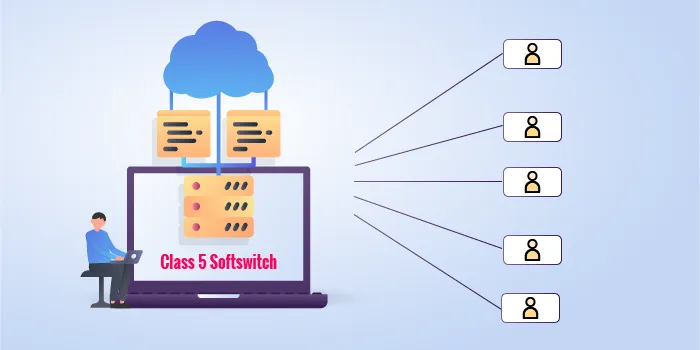
A Class 5 softswitch serves the people actually making and receiving calls. It knows each user, their numbers and devices, and delivers calls to the right phone, softphone or app.
What matters in a Class 5 switch:
- Subscriber features. Extensions, voicemail, call forwarding, call transfer, call waiting, conferencing, call recording and hunt groups.
- IVR and auto-attendant so callers can be greeted and routed without a receptionist.
- DID and number management so each customer can buy, assign and route their own phone numbers.
- Multi-tenancy so one switch can serve many business customers, each with their own users, settings and billing.
- Prepaid and postpaid billing with balances, recharges, vouchers and invoices.
- End-user clients such as mobile softphones and a browser-based webdialer, ideally under the provider's own brand.
- Customer and reseller portals so end users and resellers can manage accounts themselves.
Who uses it: internet telephony service providers (ITSPs), mobile VoIP and calling-card businesses, hosted PBX providers, unified communications providers and operators offering business phone services.
Class 4 vs Class 5 side by side
| Class 4 softswitch | Class 5 softswitch | |
|---|---|---|
| Market | Wholesale, carrier to carrier | Retail, provider to end user |
| Customers | Carriers, resellers, traders | Businesses and individual subscribers |
| Main job | Route high volumes of calls at the best cost and quality | Deliver calls and calling features to users |
| Key features | LCR, failover, rate decks, ASR/ACD reports, CPS capacity | Extensions, voicemail, IVR, DIDs, recording, softphones |
| Billing | Per-minute rating for customers and suppliers, margin per route | Prepaid and postpaid accounts, recharges, invoices |
| Traffic profile | Many calls, few customers | Fewer calls per customer, many customers |
Which one do you need?
- You buy and sell minutes between carriers: Class 4.
- You sell calling plans, a calling app or a calling-card service to consumers: Class 5, connected to a Class 4 or to wholesale suppliers for termination.
- You sell business phone systems or hosted PBX: Class 5 with multi-tenancy, IVR and softphones.
- You are an operator or MVNO launching voice: usually both, or one platform that does both jobs.
- You are an enterprise that just needs calling inside your apps or contact centre: you probably do not need your own softswitch at all. A CPaaS voice API or a hosted call centre gives you the result without running a switch.
The Voxvalley softswitch is built for the providers in the middle of that list: it handles numbers, SMS and incoming and outgoing voice, and comes with a branded softphone and webdialer, so a provider can launch a complete retail voice service on one platform.
Hosted, cloud or on-premise

- Hosted (rented). The vendor runs the switch; you pay a monthly fee. Fastest and cheapest way to start, with no servers to manage. Best for new providers and for testing a market.
- Cloud, dedicated. Your own instance in a cloud data centre, managed by you or the vendor. More control and isolation, still no hardware to buy.
- On-premise. You buy a licence and run it on your own servers. Most control, highest upfront cost and you carry the operations work. Usually chosen for regulatory or very high-volume reasons.
Voxvalley offers its products both as a white-label licence and on monthly rental, so a provider can start rented and move to its own deployment as volumes grow.
What to check before you buy
- Billing built in. A separate billing system means double data entry and reconciliation errors. Rating, invoicing and balances should be part of the switch.
- Routing flexibility. LCR, quality routing, percentage routing and failover for Class 4; per-tenant routing rules for Class 5.
- Capacity headroom. Concurrent calls and CPS well above your current peak, with a clear path to scale.
- Reporting. Real-time and historical CDRs, ASR, ACD and revenue by customer, route and country.
- Branding. Your logo and domain on portals, softphones and the webdialer if you sell to end users.
- APIs. To connect the switch to your CRM, website sign-up, payment gateway and support tools.
- Support. A vendor that answers by email, chat and phone, with an escalation path for outages at 3 a.m.
- Upgrades. How often the software is updated and whether upgrades are included.
Security and fraud
A softswitch connected to the internet is a target. Toll fraud, where attackers push calls to expensive premium destinations through a hacked account, can run up large bills within hours. The basics every switch should support:
- IP allow-listing and strong SIP credentials for every customer and device.
- Per-account limits on concurrent calls, spend and destinations.
- Blocking of high-risk prefixes and premium-rate ranges by default.
- Alerts on sudden spikes in traffic or cost.
- Encrypted signalling (TLS) and media (SRTP) where both ends support it.
- Regular software updates and access logs for the admin portal.
Voxvalley has been building voice platforms since 2009 for operators, VoIP providers and white-label partners. If you are deciding between Class 4, Class 5 or both, talk to our team about your traffic and business model.